
There is a number buried in the Federal Reserve’s latest consumer survey that deserves more attention than it is getting. The share of American workers who expect to voluntarily quit their jobs in the next twelve months has just hit a record low — dropping to 15.9%, the lowest reading since the New York Fed began tracking the metric in 2013. The mean probability of leaving one’s job voluntarily in the next twelve months decreased by 2.8 percentage points to 15.9%, a new series low.
On the surface, that sounds like stability. Workers are happy, turnover is down, companies can plan ahead. But read in the context of everything else the survey reveals, it tells a more complicated story — one about workers who feel increasingly stuck rather than satisfied.
The broader February data from the New York Fed’s Survey of Consumer Expectations presents a mixed picture. Median one-year-ahead inflation expectations declined to 3% in February 2026, the lowest in seven months, down from 3.1% in January. Consumers expect a slowdown in prices for food, medical care, and rent — but median year-ahead price change expectations for gas increased by 1.3 percentage points to 4.1%. The Iran conflict, which sent oil markets surging in the days around the survey’s fielding period, is almost certainly embedded in that gasoline figure.
Median one-year-ahead earnings growth expectations also decreased in February by 0.2 percentage points to 2.5%, just below the trailing twelve-month average of 2.6%. Workers expect to earn slightly less growth in their paychecks, are less likely to leave for something better, and are watching gas prices tick back up while rent and food costs remain elevated. That is not the profile of a confident labor force — it is the profile of one that is cautiously sitting tight and hoping things don’t get worse.
The Federal Reserve is watching all of this carefully, and the data is giving it conflicting signals. The Fed held its benchmark rate steady at 3.5% to 3.75% in January, pausing after three consecutive cuts in 2025. Most participants noted that while the level of layoffs remained low, hiring remained low as well — and several participants noted that business contacts continued to express caution in hiring decisions, reflecting uncertainty about the economic outlook. In plain English: nobody is firing people, but nobody is confident enough to hire aggressively either. The labor market is frozen in a kind of polite standoff.
The March rate decision now carries more uncertainty than it did a month ago, with market odds of a March cut having fallen sharply, though J.P. Morgan strategists still expect one rate cut in 2026. The Iran conflict’s impact on energy prices has complicated the Fed’s calculus at exactly the wrong moment — just as inflation expectations were finally drifting back toward something manageable.
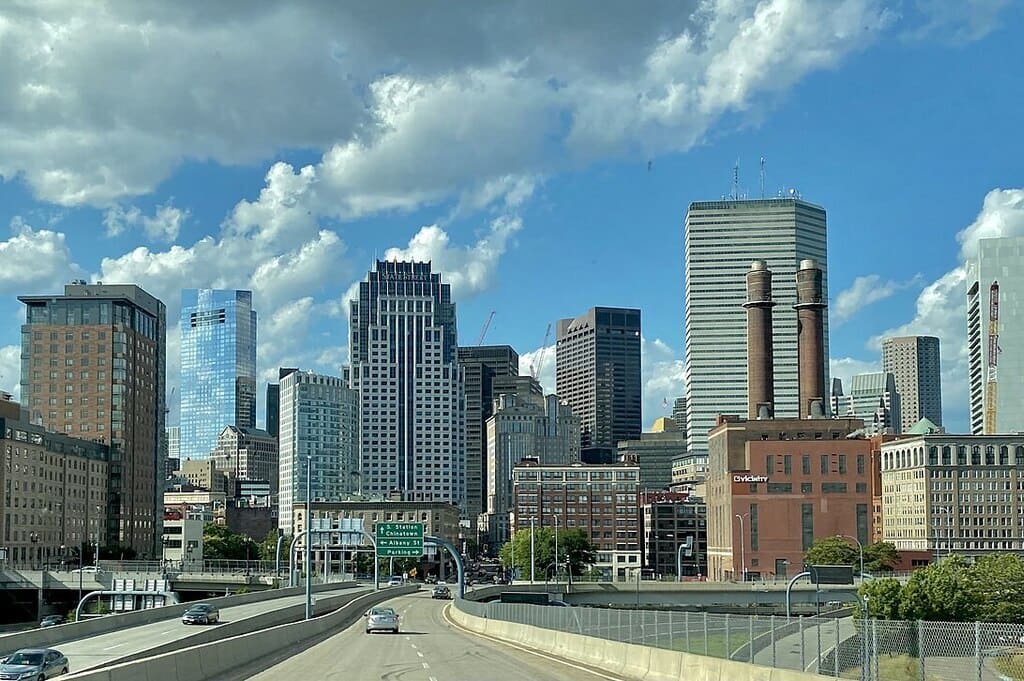
What This Means for Boston
The record-low quit rate has a specific resonance in a city whose economy runs on talent mobility. Boston’s competitive advantage — particularly in tech, biotech, and financial services — has historically been powered by professionals willing to move between companies, carry ideas across organizational lines, and bet on something new. A labor force that stops moving is a labor market that stops innovating at the edges.
For Boston’s startup ecosystem, a low quit rate means the pipeline of experienced talent leaving established firms to join early-stage companies narrows. For biotech companies trying to poach researchers from larger pharma players, it becomes harder and more expensive. For the fintech startups competing with Fidelity and State Street for software engineers, the calculus shifts — not because candidates aren’t interested, but because the risk calculus of leaving a stable job in an uncertain environment has changed.
The steady inflation expectations, on the other hand, offer genuine relief to Boston’s small and mid-sized businesses, which have spent three years navigating cost increases that hit margins from every direction simultaneously. If the 3% one-year expectation holds — and if the Iran conflict does not push energy costs materially higher over a sustained period — the operating environment for Boston businesses in the second half of 2026 looks meaningfully more predictable than it did twelve months ago.
Predictable is not the same as easy. But right now, for a city still navigating a complicated economic moment, predictable is enough.