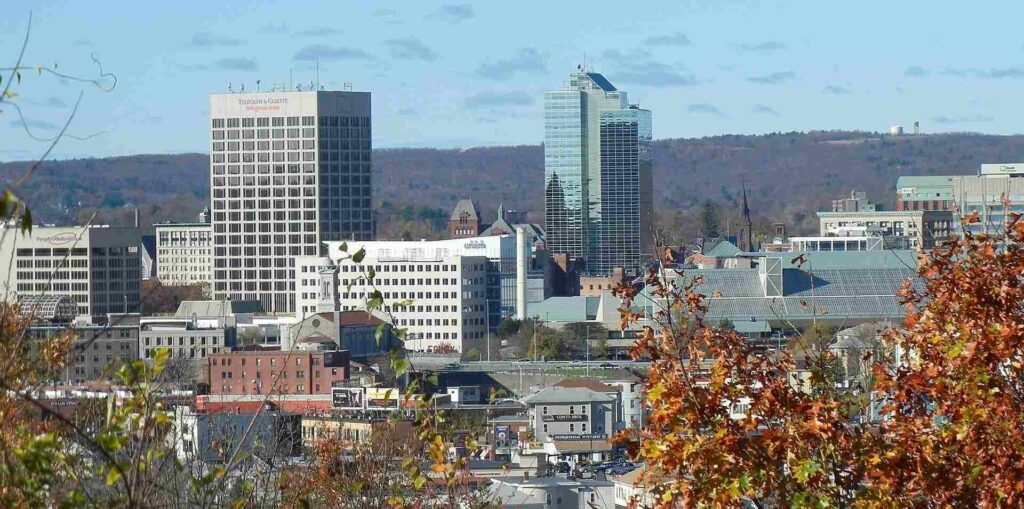
Lowell has been trying to reinvent itself for the better part of five decades. It turned its shuttered textile mills into a National Historical Park in the 1970s. It built the Hamilton Canal Innovation District on former industrial land. It launched the Lowell Innovation Network Corridor in partnership with UMass Lowell, a public-private project promising 2,000 permanent jobs and nearly 500 new residential units over ten years. Each wave brought real progress, and each wave also brought real skepticism about whether the momentum would hold.
This week’s news is different in scale from anything that came before it. An investment group backed by Omani capital has set its sights on a sweeping redevelopment of downtown Lowell, with a proposed investment figure of $2 billion — a number that would dwarf every prior development initiative in the city’s modern history combined.
The details emerging suggest a large-scale mixed-use vision for the city’s downtown core, combining residential, commercial, and hospitality components along the Merrimack River corridor that has long been identified in the city’s Lowell Forward Master Plan as a priority for transformation. The project would target a city that, despite years of incremental progress, still carries the scars of decades of post-industrial decline. More than 22% of Lowell residents lived at or below the federal poverty level as recently as 2020. The city has been working against youth outmigration, with community leaders openly acknowledging that Lowell is educating young people it cannot retain — a problem that requires not just housing but jobs, amenities, and a downtown that actually functions as a destination.
The interest from Oman-connected capital follows a broader pattern of Gulf sovereign wealth funds and private investors diversifying their real estate portfolios into secondary American cities with strong university anchors, transit infrastructure, and below-market land values relative to primary metros. The Oman Investment Authority, the sultanate’s sovereign wealth fund with over $40 billion in assets under management, has been actively expanding its international real estate footprint as part of Oman Vision 2040, its national diversification strategy. While this particular project appears to involve private capital aligned with that ecosystem rather than the OIA directly, the strategic logic is familiar: find cities where infrastructure exists, land is underpriced relative to potential, and local government is actively incentivizing development.
Lowell checks every one of those boxes. The city sits on two commuter rail lines with 45-minute service to Boston’s North Station. UMass Lowell — now one of the fastest-growing universities in Massachusetts — has more than 18,000 students and a research enterprise that generated over $105 million in sponsored research in its most recent fiscal year. The Hamilton Canal district has already attracted Draper Laboratory as an anchor tenant, bringing hundreds of high-paying engineering and defense research jobs to an area that was industrial wasteland ten years ago. The Lowell Innovation Network Corridor is adding lab and office space alongside market-rate housing. The building blocks for a functional urban economy are there. What has been missing is the kind of capital commitment large enough to pull it all together.
Two billion dollars could do that. It is, to be clear, still a proposal. Lowell has seen ambitious plans stall before — the National Historical Park was supposed to generate a tourism economy that never fully materialized, and multiple large-scale development proposals over the years have faded between announcement and groundbreaking. The questions that community groups are already raising are the right ones: what affordability commitments accompany the market-rate development, what happens to existing residents and small businesses in areas targeted for redevelopment, and what guarantees exist that the investment actually gets deployed rather than hovering as a proposal for years.
But the scale of outside interest itself tells a story. When sovereign wealth-adjacent capital from the Arabian Peninsula is circling a post-industrial city on the Merrimack River, something has shifted in Lowell’s position on the global investment map. Whether it gets built depends on what happens next.