
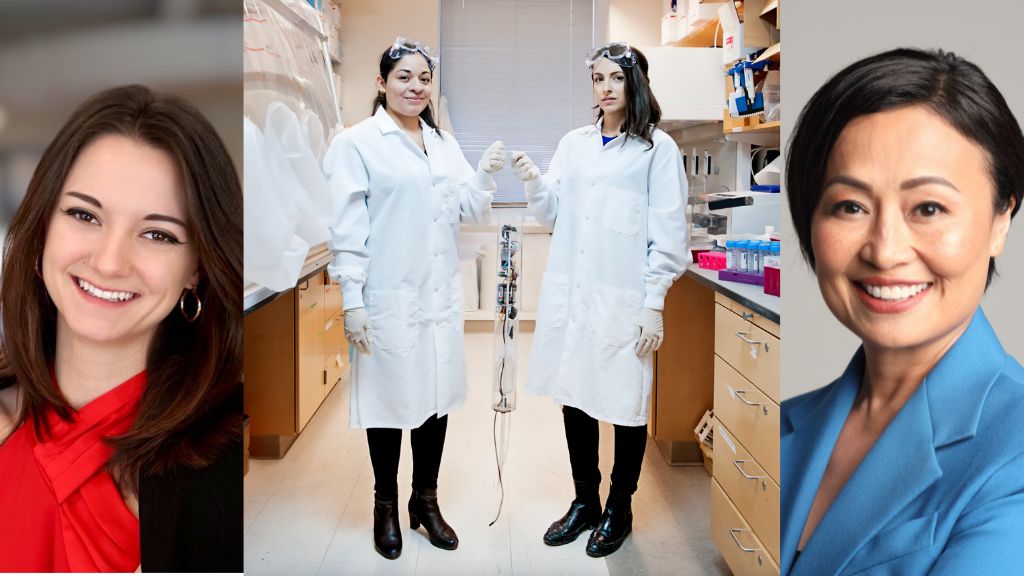
Here is a number that should bother anyone who follows the startup world: in 2024, all-female founding teams received 2.1% of all venture capital deployed in the United States. Two percent. For context, that figure was 2.4% a decade ago. A full decade of “diversity initiatives,” panel discussions, and LinkedIn posts about closing the gender gap, and the needle moved backward.
And yet. In Boston — a city where the funding infrastructure is concentrated, the academic networks are dense, and the sectors that tend to attract female founders (health, biotech, education, climate) happen to be the sectors that define the local economy — something is happening that the national statistics don’t quite capture. Women are building companies here that matter. Not in spite of the ecosystem, but often through the specific parts of it that work differently than traditional VC: public grants, academic spinouts, mission-driven accelerators, and a biotech corridor where scientific credentials carry more weight than pattern-matching on what a founder is supposed to look like.
The women on this list built real things. Some of them raised $500 million. One of them sold her company for $500 million. One of them turned sewage into a public health tool that helped cities track COVID before the hospitals knew it was coming. Another made a window material so light it floats and so insulating it outperforms triple-pane glass — and is now having her prototype displayed at the Smithsonian. These are not “women to watch.” They are women who already did it.
Sheila Lirio Marcelo — Care.com
There is a version of Sheila Marcelo’s story that gets told at Harvard Business School as a clean narrative of entrepreneurial triumph. Filipino immigrant, Mount Holyoke undergrad, Harvard JD/MBA, two kids before 30, founded a company, took it public, sold it for $500 million. Impressive sequence.
The fuller version is more interesting. Marcelo started Care.com in 2006 out of a personal problem that most investors at the time didn’t think was a real market: she couldn’t find reliable childcare. Her own father had a heart attack while she was managing two young kids and a startup. The people telling her she was “settling” by building what they called a babysitting website hadn’t spent a week trying to simultaneously manage infant care, elder care, and a Series A pitch.
Care.com launched in 2007 out of Waltham, Massachusetts. By 2012 it was the world’s largest online marketplace for family care — 7 million members, 15+ countries, a $50 million funding round that Rock Health ranked among the five largest digital health investments of that year. In January 2014, Care.com went public on the New York Stock Exchange, raising $91 million in its IPO — the first venture-backed Massachusetts tech company to debut on Wall Street in eighteen months. The stock jumped 43% on its first day of trading. Marcelo became one of only 22 women in history to have founded and led a company to IPO at that point.
The story got complicated before it ended. Vetting controversies and a Wall Street Journal investigation in 2019 hit the stock hard. IAC acquired Care.com for $500 million in 2020. Marcelo stepped down. But she didn’t stop. She co-founded Proof of Learn, an education technology company that raised $15 million from New Enterprise Associates. Then, in 2024, she launched Ohai.ai — an AI-powered household management assistant that raised $6 million in seed funding. The woman who built the Amazon of care is now building the AI chief of staff for modern family life.
Total career funding raised: $130M+. Exit value: $500M. The babysitting company turned out to be a pretty good idea.
Mariana Matus & Newsha Ghaeli — Biobot Analytics
Mariana Matus and Newsha Ghaeli first met in what they describe, without any apparent embarrassment, as a poop lab at MIT. Matus is a computational biologist from Mexico. Ghaeli is an architect from Canada. They were working on a wastewater analysis project and realized, somewhere between the data sets and the pipettes, that the sewage system was the most underutilized public health data network in the world.
Biobot Analytics, founded in 2017 out of MIT’s Media Lab and accelerated by MITdesignX, built the infrastructure to turn that observation into a product. The company’s core technology analyzes wastewater samples for pathogens, drug metabolites, and other health biomarkers, then turns the results into epidemiological data that cities, health departments, and government agencies can actually use. Before a single person showed up at a hospital with COVID-19 symptoms, Biobot was detecting the virus in the sewage systems of communities across the United States. Their wastewater data became one of the earliest and most reliable signals of outbreak trajectories during the pandemic — a fact that earned them contracts with the CDC, numerous state health departments, and eventually a place on NPR’s “How I Built This.”
Since 2018, Biobot has raised $42.7 million across five rounds. Its most recent funding round, in June 2025, was led by Valor Equity Partners, with Atreides Management joining as a new investor alongside existing backer Hyperplane. The company employs nearly 100 people. Matus’s stated mission is to build a “Human Health Observatory” — a continuous, population-level view of what is actually happening inside communities’ bodies, derived not from hospital records or self-reported symptoms but from the data everyone produces every day.
It is the kind of idea that sounds obvious in retrospect and was invisible until two scientists in a poop lab decided to take it seriously.
Elise Strobach — AeroShield Materials
Elise Strobach started AeroShield in 2019 while finishing her PhD in mechanical engineering at MIT. The technology she was working on — a transparent silica aerogel material that is 95% air, lighter than a marshmallow, and two to three times more insulating than the argon gas used in standard double-pane windows — had been sitting in the corner of materials science for decades. Aerogels were invented in the 1930s. NASA used them to insulate equipment in space. They were the most insulating solid materials ever created. They were also opaque, which meant they were useless for windows.
Strobach figured out how to make aerogel clear. That one change opened up a market worth tens of billions of dollars annually — the residential window industry, where inefficiency accounts for up to 30% of a typical home’s heating and cooling costs. AeroShield’s transparent aerogel sheet slides inside a standard double-pane window and gives it the thermal performance of an expensive triple-pane design, at a fraction of the cost and weight.
Since founding the company, Strobach has raised $29.1 million in total funding, including a $14.5 million ARPA-E award, a $1 million MassCEC grant for affordable housing installations in Boston, and investments from MassMutual Ventures, MassVentures, and others. AeroShield was named to Forbes 30 Under 30 in Energy. Strobach was named to the Boston Globe’s 2025 Tech Power Players list. The company won the 2025 Hello Tomorrow Global Challenge in sustainable construction. AeroShield’s prototype is on permanent display at the Smithsonian National Air and Space Museum. And in Q1 2027, Strobach plans to open the first full commercial manufacturing facility in Massachusetts — going from lab samples to thousands of square feet per month in eight years.
She is, by her own account, just getting started.
Irena King — Surgicure Technologies
Irena King didn’t set out to build a medical device company. She set out to fix a problem that ICU nurses and respiratory therapists had been working around for decades with nothing more than medical tape: breathing tubes that dislodge from intubated patients — a complication that, in roughly 30% of preventable cases, results in death.
King holds a PhD in Medical Engineering and Medical Physics from Harvard-MIT’s Health Sciences and Technology program, conducted research at the Wyss Institute and Beth Israel Deaconess, and holds a Healthcare Certificate from MIT Sloan. She founded Surgicure in 2019, joined the Techstars Boston Accelerator in 2024, and closed a $1.785 million seed round in early 2025, led by Launchpad Venture Group with participation from Beacon Angels, TiE Angels, BakerBridge Capital, and several others. Her device, the Horseshoe — originally conceived by U.S. Army respiratory therapists in battlefield trauma settings — won the Healthcare, AssistiveTech & BioTech category at SXSW Pitch 2026, selected from more than 600 applications from across the US and Europe.
The Horseshoe anchors to a patient’s back molars instead of their skin, providing the kind of stable, reliable tube securement that medical tape has never managed to deliver. It is a device so specific, so unglamorous, and so obviously necessary that it is hard to believe it didn’t exist before.
The Number Behind All of It
Female founders in Boston generate, by available data, 78 cents of revenue for every dollar raised — versus 31 cents for male-founded startups, according to Boston Consulting Group. They burn 15% less capital. They exit faster when they exit at all. The performance data is not ambiguous.
The funding data is also not ambiguous. All-female founding teams received 2.1% of U.S. VC in 2024. The 30-year average is 2.4%. At the current rate of change, gender parity in venture capital arrives sometime around 2065.
Boston’s version of this problem looks slightly different from the national picture. The city’s density of public funding mechanisms — MassCEC, MassVentures, ARPA-E, NSF SBIR programs — has historically given technically rigorous companies led by women a path to early capital that doesn’t require convincing a Sand Hill Road partner to break a pattern. Strobach built her first manufacturing capabilities on public grants. Matus got her first traction through MIT accelerator programs. King came through Techstars. Marcelo raised her first capital through a Boston VC firm — Matrix Partners — where she spent six months as an entrepreneur-in-residence before she had a product.
None of these paths ran through the traditional Boston VC community writing $10 million Series A checks. That is not a coincidence. It is a structural feature of the ecosystem — and for female founders in particular, it has functioned as the alternative route that the main road didn’t offer.
The question for 2026 is what happens when that alternative infrastructure comes under pressure. VentureWell — which helped fund Strobach’s earliest AeroShield research — just shut down after federal grants dried up. ARPA-H, which had become one of the more active public capital sources for women-founded health companies, is operating under new federal constraints. The NSF SBIR programs that funded dozens of Boston female-founded deep tech companies have seen budgets frozen.
The founders profiled here got through. The question is how many equally talented women in labs across MIT, Harvard, Northeastern, and Tufts right now are going to hit the same wall — and find that the public capital infrastructure that helped punch them through isn’t there anymore.
That is the story worth watching in Boston’s female founder ecosystem in 2026. Not the names already on the list. The ones trying to get on it.