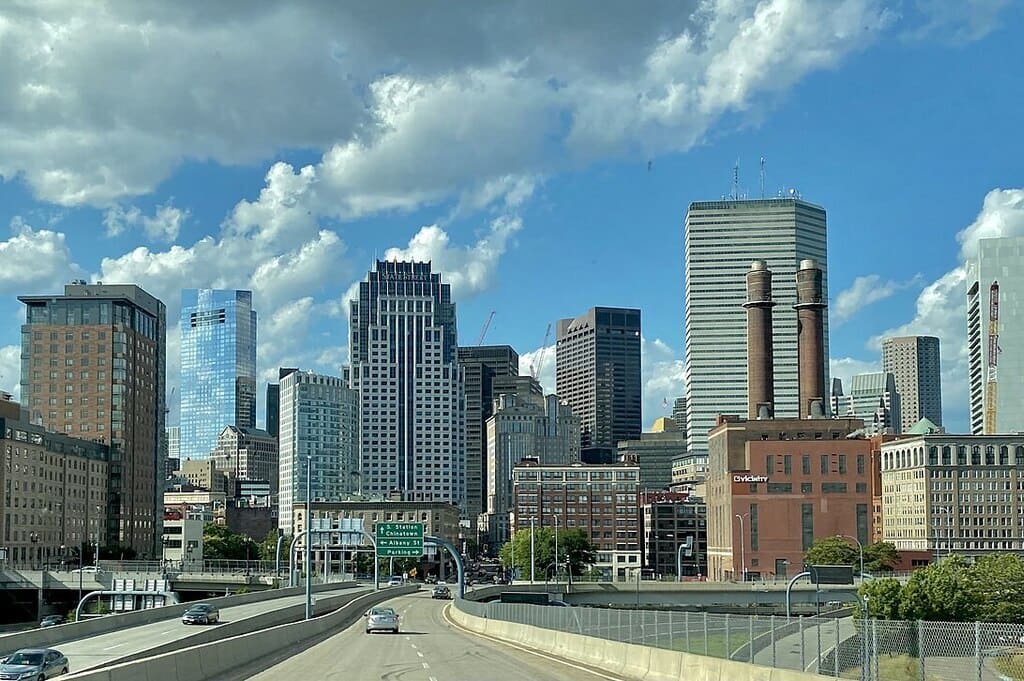
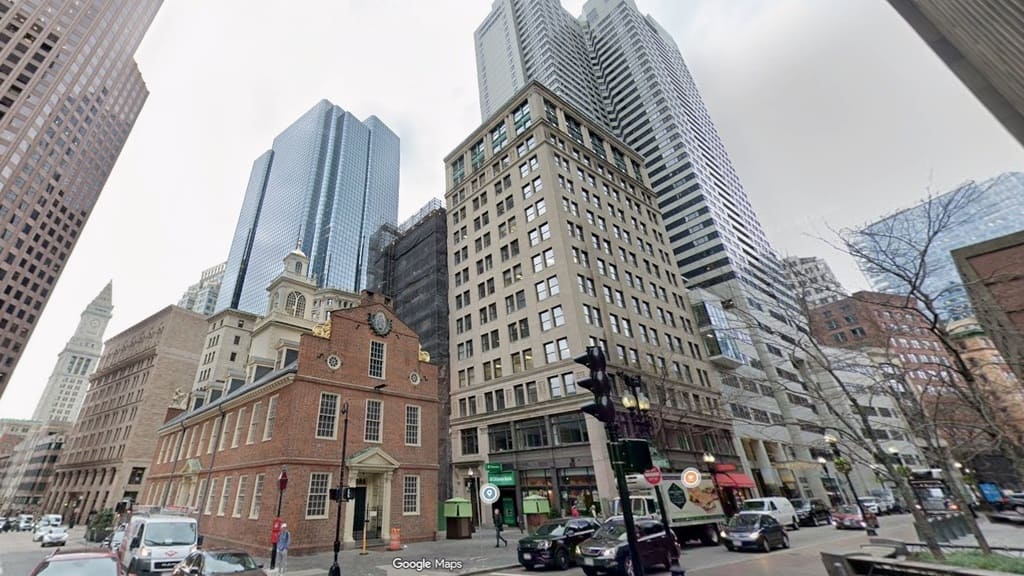
There is a 14-story office building at 1 State Street, in the heart of Boston’s Financial District, that has been quietly emptying out for years. It sits one block from Faneuil Hall, two blocks from the waterfront, steps from three MBTA lines. By almost any measure, it is exactly where people should want to live. Until recently, nobody had figured out how to make the math work to turn it into homes. That is changing.
Plans filed this week call for converting the existing commercial building at 1 State Street into residential units — the latest in a string of downtown office-to-apartment conversions that has accelerated sharply in the first quarter of 2026. The project joins a pipeline that now includes 24 applications under Mayor Michelle Wu’s Office to Residential Conversion Program, collectively on track to transform 29 buildings and 1.5 million square feet of empty office space into more than 1,700 new homes across downtown Boston.
The timing is not coincidental. Three things converged in late 2025 and early 2026 to make these projects suddenly viable in ways they weren’t eighteen months ago. The first was the federal expansion of Low-Income Housing Tax Credits, which reduced the private activity bond financing threshold for 4% credit projects from 50% to 25% — a change that unlocked rehabilitation projects that previously couldn’t pencil out. The second was the extension of Boston’s own conversion program through December 2026, which gives developers the runway they need to structure deals, secure financing, and pull permits before the incentive window closes. The third was the city’s 75% property tax abatement for 29 years, which changes the carrying cost calculus for buildings that have been generating minimal revenue from mostly vacant floors.
The broader pipeline tells the story. At 280-300 Washington Street in Downtown Crossing, the largest conversion approved by the BPDA Board to date — 219,200 square feet, 255 new homes, 52 of them income-restricted — cleared its final approval this month and will move into construction without requiring a single zoning variance, because updated downtown zoning rules now allow these conversions as-of-right. At 31 Milk Street, Dinosaur Capital is already building 110 units across 95,000 square feet. At 4 Liberty Square, 36 new apartments are coming along with a ground-floor restaurant space, with completion expected by summer 2027. The Richards Building at 112 State Street — half a block from 1 State Street — is being converted into 14 to 18 units, with completion projected for early 2028.
The vacancy numbers that made all of this necessary are sobering. Downtown Boston’s office vacancy rate has hovered around 19-20% since the pandemic — more than double pre-pandemic levels. The buildings sitting emptiest are not the new ones. JPMorgan just signed 249,000 square feet at South Station Tower. Citadel is in the same building. The tenants who are moving are moving into the newest, highest-amenity towers, leaving the older pre-war stock — the buildings that happen to be best suited for residential conversion, with their narrower floor plates, exterior windows on multiple sides, and architectural character — increasingly without commercial tenants.
That is the sweet spot the conversion program targets. And 1 State Street, a 14-story building constructed in an era when office floors were designed around natural light and human scale rather than open-plan flexibility, fits the profile precisely.
The program has its limits. Boston’s office inventory includes many modern buildings with wide floor plates and deep interior spaces that are genuinely difficult to convert — it’s hard to put a bedroom in a space that’s 80 feet from the nearest window. Affordability requirements add complexity: at least 17% of units in every conversion must be designated affordable for households at or below 60% of area median income, which compresses margins in a construction cost environment that has not gotten any cheaper. And the $15 million in state grant funding for larger conversion projects has already been fully committed to permitted projects, with no guarantee the Legislature refunds it.
Still. By the time the program closes applications at the end of 2026, the City of Boston will have converted more than 1,700 office units into homes — in buildings that existed, on land that required no new development, in neighborhoods that already have the transit, retail, and infrastructure that new construction sites spend years trying to create. At a moment when the city adds roughly two new housing units per 1,000 residents per year — one of the lowest rates of any major American city — that is not a small thing.
One State Street has been a Financial District address for decades. Soon it will be a home address. In Boston in 2026, that distinction matters more than it ever has.