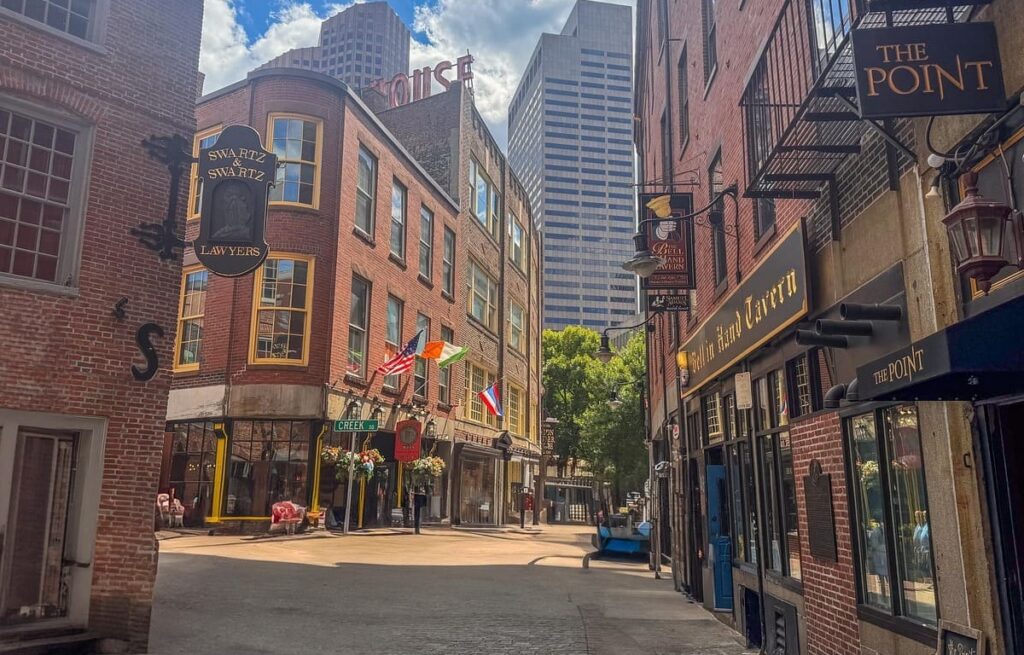
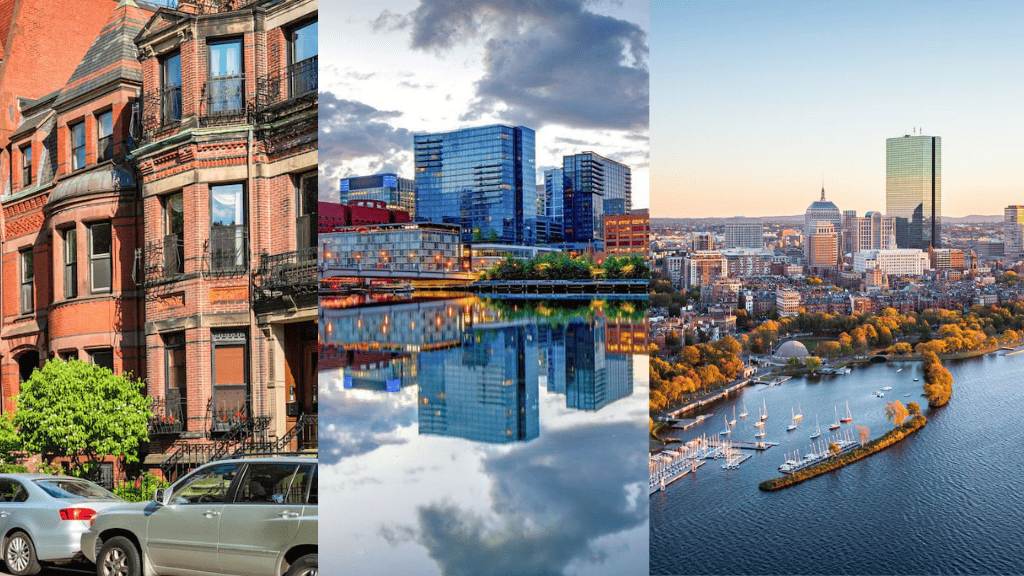
Boston is not a city where “expensive” means the same thing in every zip code. A $1.2 million budget will get you a well-appointed two-bedroom condo with harbor views in one neighborhood and a tiny studio with a galley kitchen in another. The difference is not just square footage — it is history, walkability, prestige, and the specific kind of life each street makes possible.
As of early 2026, the city-wide median sale price in Boston sits at $812,500, according to Redfin — already 92% above the national average, and in a market where overall home values have risen 163% over the past two decades. But that number is almost meaningless on its own. Boston’s real estate market is not one market. It is a collection of micro-markets, each with its own pricing logic, its own housing stock, and its own answer to the question of what you are actually buying.
Here is what the data shows — neighborhood by neighborhood.
The Financial District and Downtown: The Price-Per-Address Premium
Median sale price: $2.58M | What you get: full-service luxury condos, zero commute
If the question is strictly which Boston neighborhood has the highest median sale price right now, the answer in February 2026 is the Financial District, at approximately $2.58 million — more than three times the city median. Downtown Boston follows at roughly $1.93 million.
What justifies those numbers is not square footage. Financial District units tend to be compact — sleek, high-floor condos in modern towers like 45 Province and Millennium Tower, where the selling point is absolute centrality. You are buying the ability to walk to every major employer, every transit line, every restaurant, and the harbor in under ten minutes. In a city where a single MBTA commute can consume 45 minutes each way, that convenience carries a serious premium.
The highest single-family sale in all of Boston in 2025 was recorded in Back Bay at $21 million. Luxury condos at 240 Devonshire in the Financial District are currently listed between $1.75 million for a 900-square-foot one-bedroom and $3.06 million for a 1,667-square-foot two-bedroom. You are paying roughly $1,700 to $2,000 per square foot to sleep a five-minute walk from State Street.
Seaport District: The Highest Price Per Square Foot in Boston
Median sale price: ~$2.3M | Price per sq ft: ~$2,200 | What you get: harbor views, new construction, amenity-rich towers
Long-tail: Seaport District Boston real estate 2026, Boston Innovation District condo prices, highest price per square foot Boston neighborhood
If the Financial District wins on median sale price, the Seaport wins on a different metric that arguably tells a more accurate story: price per square foot. At approximately $2,200 per square foot as of February 2026 — up 23.7% year-over-year — the Seaport is the most expensive neighborhood in Boston by that measure, and it is not particularly close.
The reason is the product itself. The Seaport is Boston’s youngest luxury neighborhood, built almost entirely within the last fifteen years on what used to be parking lots and industrial land. The buildings are new. The apartments are wide-open, floor-to-ceiling glass, with harbor views, concierge services, rooftop amenities, and the kind of building infrastructure that historic brownstone neighborhoods cannot offer. According to the Boston Globe, the Seaport and South Boston Waterfront now have the highest concentration of high-income households in the entire city — more than 40% of residents earn above the high-income threshold.
The trade-off is a neighborhood still finding its identity. The Seaport has excellent restaurants and proximity to the convention center and the emerging life sciences corridor, but it lacks the street-level texture and human scale of older Boston neighborhoods. It is a neighborhood designed for people who prioritize new, connected, and convenient over historic and charming — and the market prices that preference accordingly.
Back Bay: Old Money, Commonwealth Avenue, and $1,627 Per Square Foot
Median sale price: ~$1.9M | Price per sq ft: ~$1,627 | What you get: brownstones, Newbury Street, the Public Garden
Back Bay is the neighborhood that most people picture when they imagine premium Boston real estate — and for good reason. Modeled after Haussmann’s Paris boulevards, it was built on filled land in the 1850s and 1860s as an intentional statement of civic ambition. Commonwealth Avenue, its central spine, is lined with gas lamp-style lighting, Victorian brownstones, and mature trees. Charles Street and Newbury Street are among the most walkable and desirable retail corridors in the city.
In early 2026, the median sale price for Back Bay condos sits at approximately $1.9 million, with a median price per square foot of $1,627 — up 19.4% year-over-year. The average sale price is $2.5 million, reflecting a market that includes some of the most expensive residential transactions in the city. A unit at 300 Boylston Street closed in January 2026 for $3.2 million. A condo at 250 Commonwealth Avenue sold for $1.17 million. The range is vast, but the floor is high.
What $1.9 million buys in Back Bay is typically a renovated one- or two-bedroom condo in a historic brownstone, with original architectural details — high ceilings, wide plank floors, ornamental millwork — updated with modern kitchens and baths. The buildings are walk-up or low-rise, which means no doorman and no amenity suite, but also no $1,500-a-month HOA fee for amenities you never use. Inventory in Back Bay is described by agents as “critically scarce,” which means desirable units still move quickly despite the broader market softening. Days on market averaged 107 in January 2026 — longer than in prior years, giving buyers slightly more negotiating power than they had during the pandemic frenzy.
The neighborhood’s long-term capital appreciation story is essentially unimpeachable. Back Bay has not had a prolonged decline in property values in living memory. The housing stock is genuinely irreplaceable — nobody is building Victorian brownstones on Paris-style boulevards in 2026 — and the location, sandwiched between the Public Garden and Fenway, with the Charles River Esplanade one block north, is as good as Boston gets.
Beacon Hill: The Most Expensive Address Per Prestige Square Foot
Median sale price: ~$1.6–1.8M | Price per sq ft: ~$1,330 | What you get: cobblestones, gas lamps, Charles Street
Beacon Hill is the neighborhood that Boston uses to explain itself to the rest of the world. Cobblestone streets. Brick sidewalks. Gas lamp street lights that have been burning since the 1800s. Federal and Greek Revival architecture built by the same craftsmen who built the adjacent Public Garden. Charles Street, running along the base of the hill, is one of the most architecturally intact 19th-century commercial streets in America.
The median sale price in Beacon Hill was approximately $1.6 million in January 2026, with some data sources citing figures as high as $1.8 million depending on the sample period. Price per square foot sits around $1,330 — lower than Back Bay and dramatically lower than the Seaport, but the calculation tells a misleading story. Beacon Hill condos are smaller on average, because the buildings themselves are smaller and older. You are not paying less per unit of desirability. You are paying for a unit of desirability that happens to come in 800 square feet instead of 1,400.
Studios in Beacon Hill start around $435,000. One-bedroom units typically run $630,000 to $800,000. Multi-bedroom units can easily clear $3 million, and top listings in the neighborhood have been priced as high as $4.99 million. The income required to comfortably carry that top end, at a 28% debt-to-income ratio, approaches seven figures annually.
What keeps Beacon Hill at the top of every Boston luxury ranking despite its older, smaller, lower-amenity buildings is the same thing that keeps it in every travel magazine and film set in the city: it looks like the idea of Boston. For buyers to whom that matters — and a significant number of them, particularly international buyers and those relocating from New York, put genuine premium on living somewhere recognizable as beautiful — Beacon Hill delivers in a way that no new-construction tower can replicate.
South End: The Artist’s Neighborhood That Went Luxury
Median sale price: ~$1.25–1.3M | Price per sq ft: ~$1,210 | What you get: Victorian rowhomes, the best restaurant scene in Boston, SoWa
The South End has one of the more interesting trajectories in Boston real estate history. For much of the 20th century, it was one of the most affordable neighborhoods in the city — Victorian rowhomes divided into rooming houses, occupied by working-class and immigrant communities. In the 1970s, artists moved in for the cheap space and the architecture. By the 1990s, it had begun the long transformation into one of Boston’s most desirable and expensive places to live.
Today, the South End has the best restaurant scene in the city — a concentration of independent, chef-driven dining on Tremont Street and Columbus Avenue that rivals anything in New York. It is home to the SoWa Art + Design District, Peters Park, and the most intact collection of Victorian brownstone rowhomes in the United States outside of New York. It is extremely walkable, dog-friendly, and culturally diverse in a way that genuinely distinguishes it from the more homogenous luxury neighborhoods nearby.
The median sale price in the South End sits at approximately $1.25 to $1.3 million as of early 2026, with a price per square foot around $1,210 — up a notable 30% year-over-year. The average household income in the neighborhood is $144,000, and 66% of residents hold college degrees. To afford the median home here by conventional mortgage standards, a household needs to earn at least $267,000 a year.
For buyers on the upper end of the luxury spectrum, the South End offers something rare: the combination of historic architecture, genuine neighborhood character, and proximity to Back Bay and the Financial District, without the premium that the Beacon Hill or Back Bay name commands. It is the choice of buyers who care more about how they actually live than about the address on their business card.
What the Numbers Actually Tell You
The question buried inside all of these figures is not which neighborhood is most expensive. It is which neighborhood is worth it — and for whom.
Boston’s overall housing market in 2026 is one defined by scarcity more than momentum. The city builds roughly two housing units per 1,000 residents annually, among the lowest rates of any major American city. Total single-family home values across Boston have risen 163% over the past twenty years. Median home prices are projected to rise an additional 2.5% to 4% through the end of 2026. With mortgage rates still above 6.5% and inventory critically low across every premium neighborhood, the buyers who are transacting are largely cash buyers or dual-income professional households with strong equity positions.
The most useful framework for thinking about Boston’s expensive neighborhoods is not price per square foot in isolation — it is what each neighborhood gives you that cannot be manufactured. The Seaport gives you new construction, harbor views, and the highest-income zip code in the city. Back Bay gives you irreplaceable architecture and the best retail corridor in Boston. Beacon Hill gives you the most recognizable and historically intact streetscape in America. The South End gives you the best food scene in New England and Victorian character without the full Beacon Hill premium.
None of them are cheap. All of them, if history is any guide, are likely to be more expensive in five years than they are today.