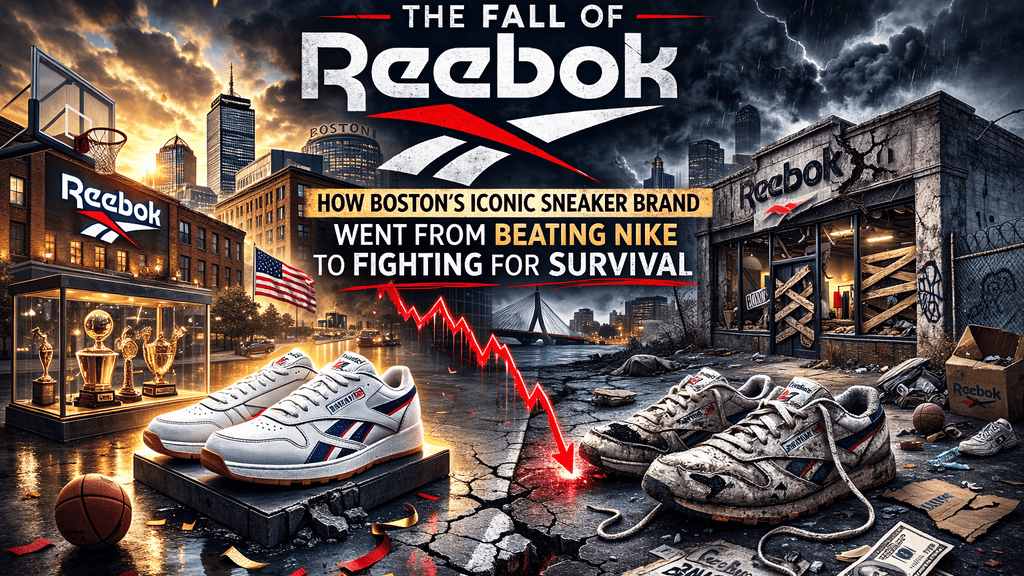
There is a photograph that captures better than any statistic what Reebok was at its peak. It is 1986. Michael Jordan has been wearing Air Jordans for two years. Nike is spending millions on advertising. And yet, on the shelves of sporting goods stores across America, the brand selling the most shoes is not Nike. It is Reebok. A company founded in a small English town, relaunched from Boston by a camping equipment salesman who never finished college, and turned into the largest athletic footwear manufacturer in the country in less than four years.
That story of meteoric rise is one of the most extraordinary in American business. The story of its fall is, if anything, even more instructive.
The Boy, the Dictionary, and the Spiked Shoes
Everything begins in 1895, in Bolton, an industrial town in northwest England. Joseph William Foster, a 14-year-old obsessed with athletics, hand-crafts a pair of shoes with spikes on the sole to gain speed while running. Local athletes adopt them, his reputation grows, and Foster founds his company: J.W. Foster and Sons. In 1924, British runners competing at the Paris Olympic Games wear his shoes. Harold Abrahams wins gold in the 100 meters in them — the story that would inspire the film Chariots of Fire decades later.
By the 1950s, the company begins to lose relevance. The founder’s grandsons, Jeff and Joe Foster, decide to break away from the family business and start their own brand in 1958. For the name, they turn to an Afrikaans dictionary that Joe had won as a child in a school race. They find the word “rhebok” — a grey African antelope — and Reebok is born.
Through the 1960s and 1970s, Reebok is a respected brand among British athletes but with limited reach. What transforms it into a global phenomenon is a chance encounter at a Chicago trade show in 1979.
Paul Fireman and the Deal of His Life
Paul Fireman was born in 1944 in Brockton, Massachusetts — the same city that produced Rocky Marciano. He grew up in Boston, studied briefly at Boston University without graduating, and joined the family business: Boston Camping, an outdoor sporting goods store. At 35, by his own account, he was a capable man without outsized ambitions, looking for something that would let him be his own boss.
At the National Sporting Goods Show in Chicago in 1979, he came across a booth displaying hand-stitched leather shoes called Reeboks. He paid the Foster family $65,000 for North American distribution rights. He brought them to market at $60 a pair — the most expensive in their category. Initial sales were modest. In 1981, with the company on the edge of running out of capital, Fireman sold a majority stake to Pentland Industries, a London-based holding company, to stay afloat.
Three years later, the bet had paid off beyond anyone’s expectations.
The Aerobics Revolution and the Years of Glory
In 1982, while Nike and Adidas fought fiercely over the male market, Fireman noticed something his rivals were ignoring: American women had embraced aerobics as a way of life, and there was no shoe designed specifically for them. Reebok launched the Freestyle — the first athletic shoe designed exclusively for women. High-cut, lightweight, and stylish enough to wear outside the gym.
The result was a sales explosion without precedent in the athletic footwear industry. In 1983, Reebok was generating $12.8 million in revenue. In 1984, Fireman bought the English company outright for $700,000. In 1985, Reebok went public on the New York Stock Exchange under the ticker RBK. In 1986, sales reached $919 million — enough to overtake Nike as the largest athletic footwear manufacturer in the United States. In 1987, revenue hit $1.4 billion. In 1988, $1.82 billion, with 26.7% of the American athletic footwear market under its control. Nike that same year generated $1.2 billion.
Fortune named it the fastest-growing company in the United States between 1983 and 1987. Forbes ranked it the most profitable among 880 companies analyzed in 1987. Reebok was not just a shoe. It was the symbol of a decade.
In 1989, the company added another icon to its catalog: the Reebok Pump, a shoe with an internal inflation system that allowed a customized fit. More than 100 professional athletes adopted it before the year was out, among them Shaquille O’Neal, then an emerging college basketball prospect.
The Mistake Nike Never Made
And then Nike signed Michael Jordan.
The Air Jordan was not just a shoe. It was the beginning of a fundamentally different brand philosophy: building an aspirational narrative around an athlete transformed into a cultural icon. Nike was not selling footwear. It was selling the idea that you, wearing those shoes, could be something more than you already were. Jordan was the vehicle. The shoes were the ticket.
Reebok did not understand this in time. Its advantage in the 1980s had been tactical — identifying an underserved market and filling it before anyone else. But it had not built a brand with that emotional depth. When Nike reclaimed the number one spot in 1989 on the strength of Jordan, Reebok responded with what it knew how to do: more products, more lines, more diversification. Rockport in 1986. Avia in 1987. NFL, NBA, MLB, and NHL sponsorships in the 2000s. The strategy of “being good at everything” turned out to be the strategy of “being indispensable at nothing.”
The most revealing moment of this strategic tension came in 2002. Reebok attempted to sign LeBron James, who was leaving high school as the next great icon of global basketball. Nike took him for $90 million. Without its Jordan, Reebok pivoted toward music: Jay-Z and 50 Cent signed with the brand and launched the S. Carter and G-Unit sneakers respectively. The shoes sold well initially, but without the narrative continuity of an active athlete at the peak of his career, the momentum faded.
In 2005, when Adidas announced the acquisition of Reebok for $3.8 billion, the brand was still generating $3.77 billion annually and held 10% of the global athletic footwear market. It was number two in the United States. It was not a lost cause. It was a company with an identity problem looking for an owner who understood it.
What it found was the opposite.
Fifteen Years Inside the German Cage
On paper, the Adidas-Reebok merger made sense. Adidas was strong in Europe and in soccer. Reebok was strong in the United States and in fitness. Together, with a combined market share approaching 20% in the American market, they could genuinely challenge Nike. That was how Adidas sold it in August 2005, when Reebok’s stock jumped 30% in a single day on news of the deal.
The reality was radically different. Rather than reinforcing and amplifying Reebok’s identity, Adidas diluted it. The first move after the acquisition was to strip Reebok of its official NBA uniform supplier contract — which went to Adidas. Reebok lost the NFL contract in 2012, replaced by Nike. Under Armour took baseball. By 2015, Reebok’s U.S. market share had fallen to barely 1%. Adidas that same year held 4%. Between the two brands that had together owned 20% of the American market, they could barely scrape together 5%.
For fifteen years, Adidas tried strategy after strategy to revive Reebok. The 2016 “Muscle Up” plan closed 40 company-owned stores. Collaborations with Victoria Beckham, Gal Gadot, and Cardi B. A return to fitness and CrossFit — a bet that echoed the aerobic origins of the 1980s, which worked reasonably well in international markets but never took off in the United States. By the time the pandemic arrived in 2020, Reebok sales fell an additional 16%. In 2020, the brand that had generated $3.77 billion in 2005 was producing $1.61 billion. In fifteen years, it had lost more than half its size.
In February 2021, Adidas announced what had long been an open secret: Reebok was for sale.
Shaq, ABG, and the Attempt at Resurrection
The sale closed in August 2021, when Authentic Brands Group — a New York company specializing in acquiring damaged brands and reactivating them through licensing — acquired Reebok for $2.5 billion. Adidas lost $1.3 billion on the transaction compared to what it had paid sixteen years earlier. Analyst Matt Powell of the NPD Group summarized the story in one sentence: it was a “marriage that was doomed from the start.”
Behind the deal was an unlikely lobbyist: Shaquille O’Neal, who had been tied to Reebok since 1992 and was a shareholder in ABG. Shaq literally called ABG executives every day urging them to close the deal. In October 2023, he became President of Basketball at Reebok — a full circle for someone who had worn the Pumps during the brand’s golden years.
ABG licensed Reebok’s U.S. operations to SPARC Group — its joint venture with Simon Property Group, the largest mall operator in the country — and distributed other regional licenses across Europe, Australia, Latin America, and the rest of the world. Reebok’s global headquarters remains in Boston, in the Seaport District, where approximately 450 people work today, focused primarily on design and brand management. In 2006, when Adidas acquired it, there were 1,200 employees in the Boston area alone.
The message from the new owners was straightforward: after 15 years as a neglected subsidiary of a German corporation, it was time to let Reebok be Reebok again.
What Remains — and What Was Lost
The brand has real assets. The Classic Club C-85 remains one of the best-selling models among young people in the United Kingdom. The Freestyle and the Pump are cultural icons with genuine nostalgia behind them. The CrossFit segment generates steady business. And in a global activewear market valued at more than $350 billion, there is room for a brand with history and international recognition.
But what was lost between 1989 and 2021 is harder to recover than market share. Nike built during those years something that goes far beyond athletic footwear: a cosmology of human ambition in which Jordan, Kobe, LeBron, Federer, and Tiger Woods are the saints of a modern pantheon. Reebok had its version in Allen Iverson — the only player who genuinely threatened Jordan’s cultural dominance in the 2000s — but it lacked the continuity and structure to sustain it.
Paul Fireman, the camping salesman who turned a small English craft company into the largest athletic footwear manufacturer in the world, said something in a 2021 interview that captures it all: “I caught them at the top. We were doing well, making a lot of money. But they were bigger and better. And they knew it.”
The story of Reebok is, at its core, the story of a company that won a brilliant tactical battle — aerobics, women, fitness — and lost the long-term strategic war: the battle to become something more than shoes.
From the Seaport District in Boston, with 450 employees and a brand still worth billions, the question is whether ABG can finish what Fireman started — and whether there is a LeBron waiting somewhere that nobody has signed yet.