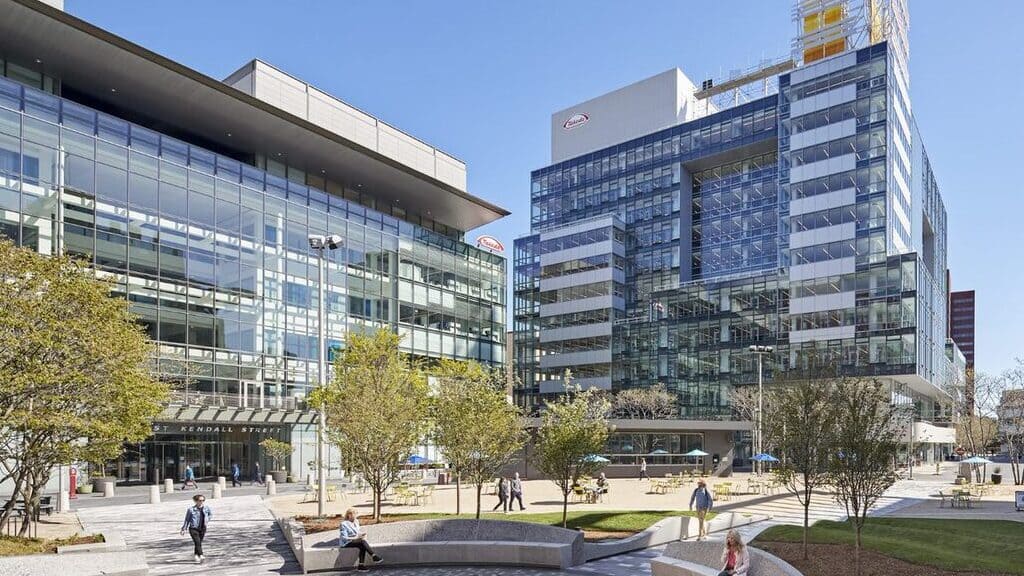
There is a pattern worth naming here. In 2024, Takeda announced a major restructuring that cut hundreds of Massachusetts jobs. In 2025, the Japanese pharmaceutical giant eliminated more Cambridge positions after shutting down its cell therapy program entirely. And this week, the company filed a WARN Act notice with the state of Massachusetts confirming that nearly 250 employees at its 500 Kendall Street location will be laid off beginning in July 2026, with some separations extending into 2027.
Three rounds of cuts in two years. At one point, Takeda was one of the largest life sciences employers in Cambridge, with a sprawling footprint across Kendall Square that it built aggressively after its $62 billion acquisition of Irish drugmaker Shire in 2019 — a deal that made it the eighth-largest pharmaceutical company in the world and brought its U.S. headquarters firmly to Massachusetts. That footprint is now shrinking in ways that are hard to ignore.
The cuts announced this week are part of a transformation plan approved by Takeda’s board on March 25 that the company says will generate more than 200 billion Japanese yen — roughly $1.25 billion — in annualized savings by fiscal 2028. The stated rationale is familiar to anyone who follows large pharmaceutical restructuring cycles: simplify operations, reduce overhead, and redirect resources toward an upcoming pipeline of product launches. CEO-elect Julie Kim framed it in the language of preparation and momentum. In practice, it means 250 fewer people working in Kendall Square by next year.
The physical footprint tells its own story. In February, Takeda put more than 630,000 square feet of Cambridge lab and office space on the sublease market — a number that stands out even in a Greater Boston commercial real estate market already carrying record-high vacancy rates. The company is consolidating its Massachusetts operations into a new research and development hub at 585 Kendall Street, expected to open later in 2026. A smaller, more focused operation. Fewer people. Less space.
For Cambridge’s biotech corridor, the Takeda news lands at a moment that already feels unsettled. Moderna, which built one of the most celebrated stories in Massachusetts biotech history with its COVID vaccine, has been cutting costs since 2023 and is targeting cash-flow breakeven by 2028 after revenue fell from $19 billion at peak to $1.9 billion in 2025. Thermo Fisher Scientific announced layoffs in Franklin earlier this year. Disc Medicine cut one in five employees after an FDA rejection. The broader narrative of a Massachusetts biotech sector in confident expansion has been complicated, repeatedly, by a post-pandemic correction that has lasted longer than most analysts predicted.
Takeda’s situation has its own specific texture. The Shire acquisition loaded the company with roughly $30 billion in net debt and forced years of asset sales and portfolio pruning to get the balance sheet back into shape. The Cambridge buildout — Takeda leased approximately 1.1 million square feet at 500 Kendall Street alone, one of the largest single-tenant lab leases in Boston history when it was signed — reflected an era of cheap capital, aggressive growth ambitions, and a life sciences real estate market that was pricing space like the boom would never end. It ended. The 630,000 square feet now available for sublease is, in part, the physical residue of a strategy that made sense at zero interest rates and stopped making sense when they weren’t.
What doesn’t change is Takeda’s underlying presence in Massachusetts. The company still employs thousands of people across the state, still considers Cambridge its U.S. operational center, and is actively building its next-generation R&D hub at 585 Kendall. The pipeline Kim referenced is real — Takeda has several potential blockbusters in late-stage development across rare diseases, neuroscience, and oncology. The restructuring is a bet that a leaner organization gets those drugs to market faster and more profitably than the current one.
For the 250 employees facing July notices, that context doesn’t change much. For Cambridge, the question is whether the next wave of Kendall Square growth — the smaller startups, the academic spinouts, the companies now leasing the space that Takeda is giving back — fills the gap faster than it opened.
It has before. Whether it does again is worth watching.