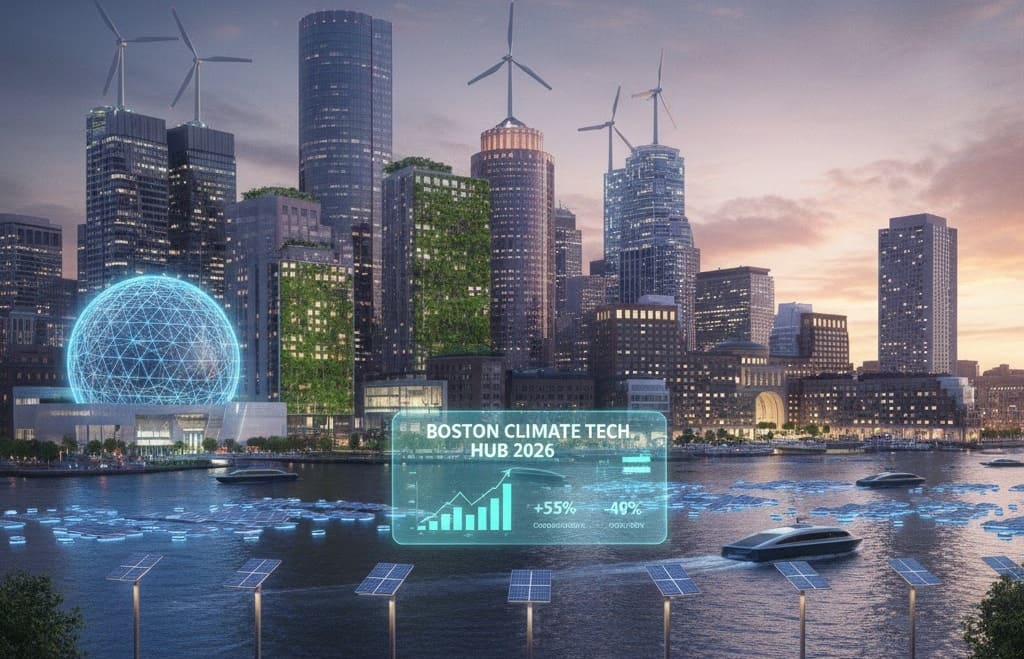
While the world was looking at Silicon Valley for software and Austin for chips, Boston was quietly building the infrastructure for the next industrial revolution: Climate Tech.
As of early 2026, the city has officially transcended its reputation as just a “Biotech hub” to become the laboratory for the planet’s survival. This isn’t just a trend; it’s a multi-billion dollar economic strategy backed by the state of Massachusetts.
The “CriticalMass” Revolution
One of the most significant shifts this year is the full activation of the CriticalMass program, led by the Massachusetts Clean Energy Center (MassCEC). This isn’t your typical startup grant.
-
The Funding: Growth-stage startups are now receiving grants of up to $1,000,000 specifically to transition from pilot projects to full commercial deployment.
-
Real-World Impact: Companies like AeroShield have already secured $1M through this program to deploy advanced aerogel-insulated windows in affordable housing communities throughout Boston, proving that the technology is hitting the streets, not just the labs.
Massachusetts as a “Climatetech Lab”
Under the “Mass Leads Act” and the state’s 10-year economic strategy, Massachusetts is positioning itself as the global “Sandbox” for green innovation.
Key Data Points for 2026:
-
The Climate Tech Tax Credit: The state has implemented a $30 million annual tax incentive program (CTIP) administered by MassCEC. This includes refundable credits for companies that create at least five net new jobs in the sector.
-
Capital Investment: Large-scale facilities can now receive tax credits covering up to 50% of their total capital investment, making Boston the most financially attractive city in the U.S. for climate manufacturing.
-
The “Corridor” Effect: The innovation doesn’t stop at the Seaport. The “Climate Tech Corridor” now stretches from the Berkshires to Cape Cod, with Greater Boston acting as the central powerhouse of research and talent.
The Seaport and Beyond: Where the Future is Being Built
The physical transformation of Boston is most visible in the Seaport District and Somerville. These areas have evolved from industrial zones into “Living Labs.”
The Rise of “Tough Tech”
Boston is leading what experts call “Tough Tech”—innovations that require physical hardware and deep science, not just apps.
-
Form Energy (Somerville): This MIT spinoff is revolutionizing the grid with its iron-air batteries. Unlike lithium-ion, these can store energy for 100 hours at a fraction of the cost. In 2026, they are a cornerstone of Massachusetts’ goal to reach 100% clean energy.
-
Commonwealth Fusion Systems (Devens/Greater Boston): Emerging from the quest for limitless clean energy, this company represents the massive scale of private investment flowing into the region, proving that Boston can handle projects of global significance.
The Strategic Pivot: From Digital Assets to “Hard” Assets
A fascinating trend in 2026 is the migration of capital. Investors who spent the last decade chasing returns in FinTech and Digital Assets are now diversifying into Climate Tech.
Why the shift?
-
Regulatory Stability: Unlike the volatile crypto landscape, Climate Tech in Boston is heavily subsidized and protected by state law (like the Mass Leads Act).
-
RWA (Real World Assets): Investors are looking for “tokenizable” physical infrastructure. A carbon capture plant in the Seaport or a fleet of electric ferries in the Boston Harbor offers a tangible yield that digital-only assets often lack.
-
Institutional Mandates: Boston’s massive asset managers (Fidelity, State Street) are under increasing pressure to meet ESG (Environmental, Social, and Governance) targets, funneling billions into local green startups.
Fast Facts: The 2026 Boston Climate Economy at a Glance
To understand the sheer scale of the transformation happening in Massachusetts, look no further than these key indicators:
-
The $30 Million Incentive: As of 2026, the Climatetech Tax Incentive Program (CTIP), administered by MassCEC, has reached its annual cap of $30 million. This program provides refundable tax credits for capital investments in climatetech facilities and job creation, specifically targeting companies that add at least 5 net new jobs to the local economy.
-
The 115,000 Milestone: Massachusetts now supports more than 115,000 clean energy workers—effectively doubling the sector’s workforce since 2010. This talent pool is one of the densest in the world, fueled by a network of over 7,500 clean energy businesses across the Commonwealth.
-
Incubator Power: Greentown Labs (headquartered in Somerville) has officially supported over 625 startups since its inception. In 2026, these companies have collectively raised more than $11 billion in funding and created over 16,500 jobs, solidifying its position as the largest climatetech incubator on the planet.
-
Investment Efficiency: Under the Mass Leads Act, certified climatetech companies can now receive tax credits covering up to 50% of their total capital investment for new facilities, provided they meet specific employment milestones.
-
Economic Contribution: The clean energy industry has added an estimated $15.9 billion to Massachusetts’ Gross State Product (GSP) since 2012, representing a staggering 74% increase in economic impact over the last decade.
Conclusion: An Invitation to Global Capital
Boston has successfully created a “Flywheel Effect.” The talent comes from Harvard and MIT, the testing happens in the MassCEC Sandboxes, and the scaling is funded by Boston’s Venture Capital elite.
For the international observer, the message is clear: Boston is no longer just a place to study history; it is the place to invest in the future of the planet. The “Boston Model” of collaboration between government, academia, and private capital has created a moat that few other cities can cross.